
Blog
White Rosary Beads Meaning: Catholic Symbolism of Purity, Grace, and Sacred Beginnings

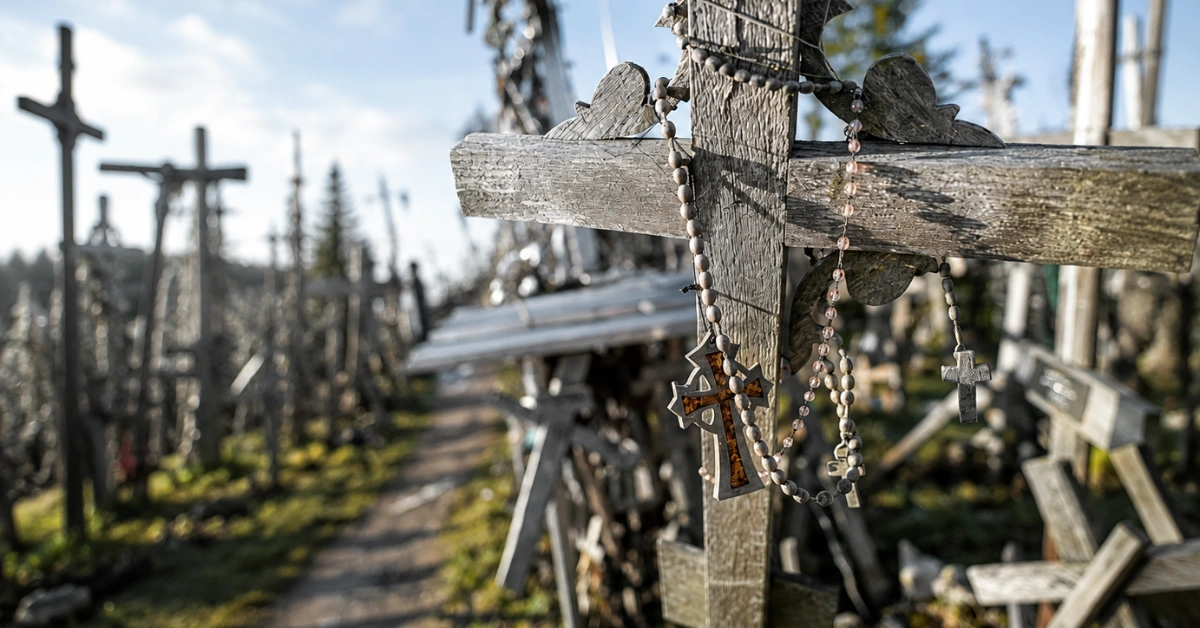
White holds a silence that no other color possesses. In the language of Catholic tradition, that silence is not emptiness — it is fullness. White is the color that contains all colors within itself, the color of light before it fractures into the spectrum, the color the Church places on its altars at the two greatest moments of the liturgical year — Christmas and Easter.
The white rosary beads meaning draws from this entire tradition — centuries of Catholic theology, liturgical color, and Marian devotion compressed into the pale luminosity of beads passing through the fingers during prayer.
To understand what a white rosary means is to understand something essential about how the Catholic faith reads the physical world — as a language in which color, material, and light carry theological weight before a single word is spoken.
White in Catholic Liturgical Tradition
The Catholic Church speaks through color with the precision of a theologian and the instinct of an artist. Every liturgical color appears in the Church’s calendar at specific moments chosen with doctrinal intention — and white appears at the moments of greatest joy and greatest holiness.
White vestments fill Catholic churches on:
Christmas Day — the Incarnation of the eternal Word, God taking flesh in the silence of a winter night, the divine light entering the darkness of the world.
Easter Sunday — the Resurrection of Christ from the tomb, death overcome, the white linen burial cloths left behind as the first evidence of the greatest event in human history.
The Feast of the Immaculate Conception — December 8th, celebrating Mary’s preservation from original sin from the first moment of her existence — the purest human soul ever created, clothed in white.
First Communion, Baptism, Confirmation — the three sacraments of initiation through which a soul enters and deepens its life in the Catholic faith, each accompanied by white garments expressing the purity and new life the sacrament confers.
The feast days of virgins and confessors — saints whose holiness the Church honors with the color of the divine light they reflected during their lives.
White in Catholic tradition is not the color of absence. It is the color of the presence of God — the blinding white of the Transfiguration on Mount Tabor, the white of the angels at the empty tomb, the white robes of the saints in the Book of Revelation who have washed their garments in the blood of the Lamb.
White Rosary Beads Meaning — The Complete Theology
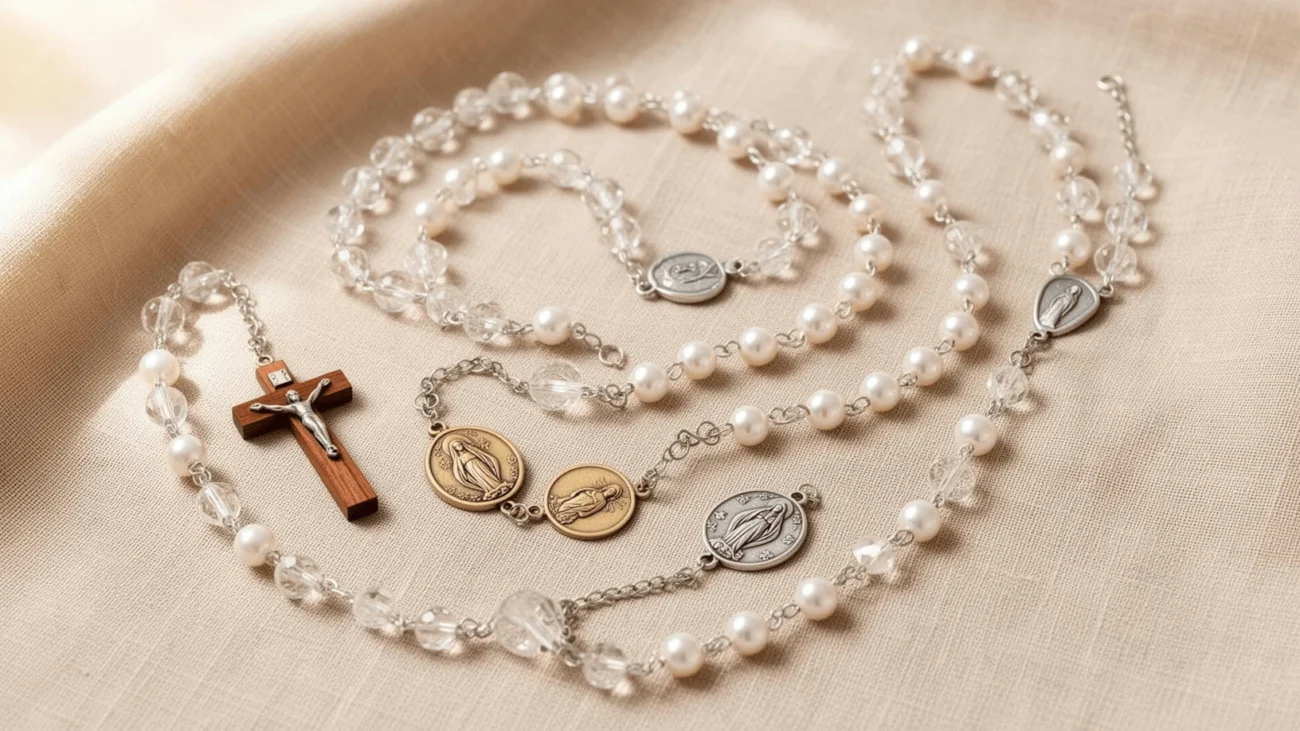
The white rosary meaning rests on four theological pillars — each one drawing from a distinct dimension of Catholic faith and liturgical tradition.
Purity and Innocence
White has represented moral and spiritual purity in Catholic sacred tradition since the earliest centuries of the Church. The white baptismal garment — placed on the newly baptized immediately after the water is poured — is the first sacred white object a Catholic receives. The priest’s words at that moment capture the theology precisely: “You have become a new creation and have clothed yourself in Christ. See in this white garment the outward sign of your Christian dignity.”
The white rosary carries that baptismal theology into the daily prayer life of the person who holds it — a continuous reminder of the dignity received in the waters of baptism and the call to live from within that dignity rather than beneath it.
Divine Light and the Resurrection
White is the color of the Risen Christ.
The Transfiguration — the moment on Mount Tabor when Christ’s divine nature broke through the surface of His human appearance — is described in all three synoptic Gospels with the same insistence on white. Matthew writes that “His face shone like the sun, and His clothes became as white as the light.” Mark notes that “His clothes became dazzling white, whiter than anyone in the world could bleach them.” Luke records that “the appearance of His face changed, and His clothes became as bright as a flash of lightning.”
This is the white that the Resurrection restores — not the white of human innocence but the white of divine glory, the light that death could not extinguish and the tomb could not contain. The white rosary prayed on Easter Sunday or through the Glorious Mysteries carries this Resurrection theology in its color — each bead the color of the light that broke from the empty tomb.
Marian Purity — The Immaculate Heart
The white rosary holds a specific Marian dimension rooted in the devotion to the Immaculate Heart of Mary — the theological reality of Mary’s heart preserved from all stain of sin and consecrated entirely to God from the first moment of her existence.
At Fatima, Our Lady asked specifically for devotion to her Immaculate Heart — promising that this devotion would bring peace to the world and the conversion of sinners. The white rosary is a natural devotional companion for this Fatima request — its color the visual expression of the Immaculate Heart’s purity, its beads the instrument of the very prayer Our Lady requested.
Devotion to Mary’s Immaculate Heart does not compete with devotion to the Sacred Heart of Jesus — it flows from it. Mary’s heart is immaculate precisely because it is entirely ordered toward her Son. A white rosary prayed with this intention places the person praying within the Fatima message — inside the specific Marian devotion Our Lady herself identified as the path to peace.
Hope and New Life
White carries the Catholic virtue of hope in a way no other color quite captures — not the optimism of human temperament but the theological hope that rests on the certainty of God’s promises and the reality of the Resurrection.
The white rosary is the natural color for prayer at the thresholds of life — the moments of beginning that Catholic faith marks with white: birth, baptism, first reception of the Eucharist, marriage, and the final threshold of death, where the Catholic funeral rite places white vestments on the altar and a white pall over the coffin in a deliberate echo of the baptismal garment — the soul returning to God clothed in the same white with which it first entered the Church.
White Rosary for Baptism — The Most Natural Catholic Gift
Of all the occasions that call for a white rosary, baptism stands first — not simply because white is the baptismal color but because a rosary given at baptism places the entire future prayer life of the newly baptized under the protection of Our Lady from the very beginning.
A white rosary gifted at baptism carries a specific intention within it — that the life just begun in the waters of the sacrament will be lived in the Marian protection of the rosary, that the prayers prayed on those beads over a lifetime will be the prayers through which God shapes the soul He claimed in the water.
For parents choosing a baptism gift that carries genuine theological weight — that speaks something true about what they are asking for their child in the sacrament — the Italian white wood rosary is among the most honest choices available. Its white wooden beads combine the purity of the color with the warmth of natural material — a rosary that will survive the decades of prayer it is meant to accompany.
White Rosary for First Communion — The Second Baptismal Threshold
First Holy Communion is the second great threshold of Catholic initiation — the moment when the baptized child receives the Body and Blood of Christ for the first time and the Eucharistic life of the Church begins in earnest.
The white dress worn by girls at First Communion, the white suit worn by boys, the white flowers on the altar, the white altar cloth — the entire visual language of First Communion speaks the same theological word. Purity. New life. The soul made ready for God’s own Body through the grace of the sacraments.
A white rosary given at First Communion places the Eucharistic life and the Marian life of the child in the same devotional object — the rosary that begins the day’s prayer leading the soul toward the Mass, the Mass leading the soul back to the rosary, the two great Catholic prayers of the Church reinforcing each other across a lifetime.
Our white crystal rosary is crafted for exactly this sacred beginning — its white crystal beads carrying the luminosity of the occasion in every bead, its quality built for the decades of prayer it is meant to initiate.
White Rosary for Weddings — The Vocation of Covenant Love
Catholic marriage is not a contract. It is a sacrament — a covenant that participates in the love of Christ for His Church, an indissoluble bond through which two souls commit to the mutual sanctification of each other until death.
The white wedding dress carries the same theological language as the baptismal garment — the bride clothed in white as an expression of the purity and new life of the sacramental covenant being entered. A white rosary given as a wedding gift places the marriage under the specific protection of Our Lady — the woman whose own marriage to Saint Joseph modeled the faithful covenant love that Catholic tradition has always held as the standard for Christian marriage.
Many Catholic couples include a white rosary in their wedding ceremony — placing it before the image of Our Lady in the church as an act of Marian consecration over their marriage, or intertwining the rosary with their hands during the ceremony as a symbol of the faith that will hold their covenant together.
White Rosary Necklace — Worn Faith and Daily Devotion
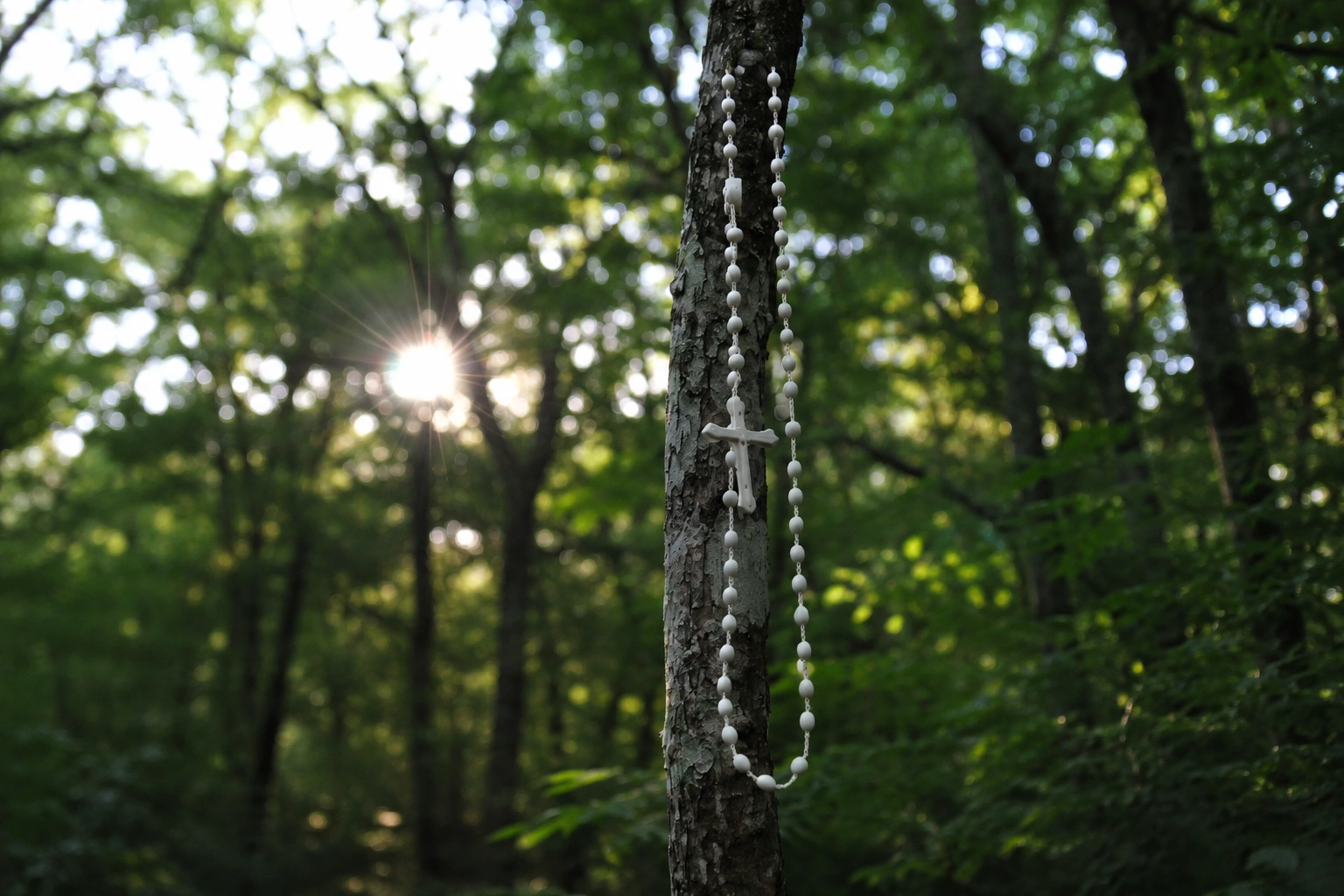
Beyond its role as a gift for specific sacramental occasions, the white rosary necklace is among the most versatile choices for daily devotional wear — its color clean and luminous against any background, its symbolism speaking quietly of the faith it expresses without demanding the attention that more dramatic colors command.
Catholics who wear their rosary as a necklace — a tradition stretching back through the centuries of the faith — find the white rosary necklace particularly suited to everyday wear. Its clarity does not compete with the environment in which it is worn. It simply declares, quietly and persistently, that the person wearing it belongs to a tradition of prayer that white has always symbolized.
The Italian white wood rosary carries the additional dimension of natural material — the white of the wood warmer and more organic than crystal, its tactile quality during prayer distinctly different from the smooth luminosity of crystal beads. Both serve the devotion equally. The choice between them is the choice between two different qualities of white — the crystalline and the earthy — and ultimately two different expressions of the same theological reality.
White Rosary and the Glorious Mysteries
The white rosary finds its most natural home within the Glorious Mysteries — the five meditations on the Resurrection, Ascension, Pentecost, Assumption, and Coronation that bring the rosary’s cycle to its triumphant conclusion.
These are the mysteries of light and triumph — death overcome, heaven opened, Mary assumed and crowned, the Holy Spirit transforming the fearful disciples into the apostolic Church that has carried the faith to every corner of the earth.
The white rosary prayed through the Glorious Mysteries creates a unity between the color of the beads and the color of the realities being contemplated — the white of the Risen Christ, the white of the angels at the Ascension, the white robes of the saints in the Coronation vision of the Book of Revelation. Bead by bead, the color of the prayer reinforces the content of the mystery, creating an integrated devotional experience that engages both the senses and the intellect.
The full theology of how different rosary colors connect to specific mysteries is covered in our complete guide to all rosary colors and their meanings — the white rosary sitting at the luminous end of the entire color spectrum, carrying the fullest expression of Catholic hope and divine glory.
Conclusion
White is the color that Catholic tradition places at its greatest moments — the birth of Christ, the Resurrection, the purity of Mary, the beginning of sacramental life.
The white rosary carries all of that within its beads. Every decade prayed on white beads is a prayer offered from within the theological reality the color expresses — purity, new life, divine light, the hope that does not disappoint because it rests not on human optimism but on the certainty of an empty tomb.
Whether chosen for baptism, First Communion, a Catholic wedding, or the simple daily fidelity of a rosary prayed at dawn — the white rosary speaks before the first prayer is said. Its color is already a theology. Its beads are already a declaration. What remains is only the prayer itself — and the grace that comes with it.
Frequently Asked Questions
A white rosary symbolizes purity, baptismal grace, the Resurrection, and new life in Catholic faith. White is the liturgical color of Christmas, Easter, and the feast of the Immaculate Conception — making it the most luminous and joyful of all rosary colors.
White rosaries are most traditionally used for baptism, First Communion, and wedding gifts — the three great sacramental thresholds marked by white in Catholic practice. They are also prayed specifically with the Glorious Mysteries and for Marian intentions connected to the Immaculate Heart.
A white rosary given as a gift carries the Catholic theology of new life, purity, and Marian protection — making it the most theologically precise gift for baptism, First Communion, Confirmation, and marriage. It places the recipient under Our Lady’s mantle at the beginning of a new chapter in faith.
No — white rosaries are appropriate for any Catholic regardless of gender. While white is frequently chosen for girls at First Communion, its symbolism of baptismal grace, the Resurrection, and divine purity belongs to every Catholic equally.
A white crystal rosary carries luminosity — its beads refracting light during prayer in a way that reflects the Resurrection theology of white. A white wood rosary carries warmth — its natural material connecting the color’s purity to the earthy reality of the Cross and creation. Both carry identical theological symbolism through different material expressions.
Yes — a white rosary can be prayed with any set of mysteries. Its most natural home is the Glorious Mysteries, but the purity and new life it symbolizes are present in every mystery from the Annunciation to the Coronation.