
Blog
All Rosary Colors and Their Meanings: The Complete Catholic Guide

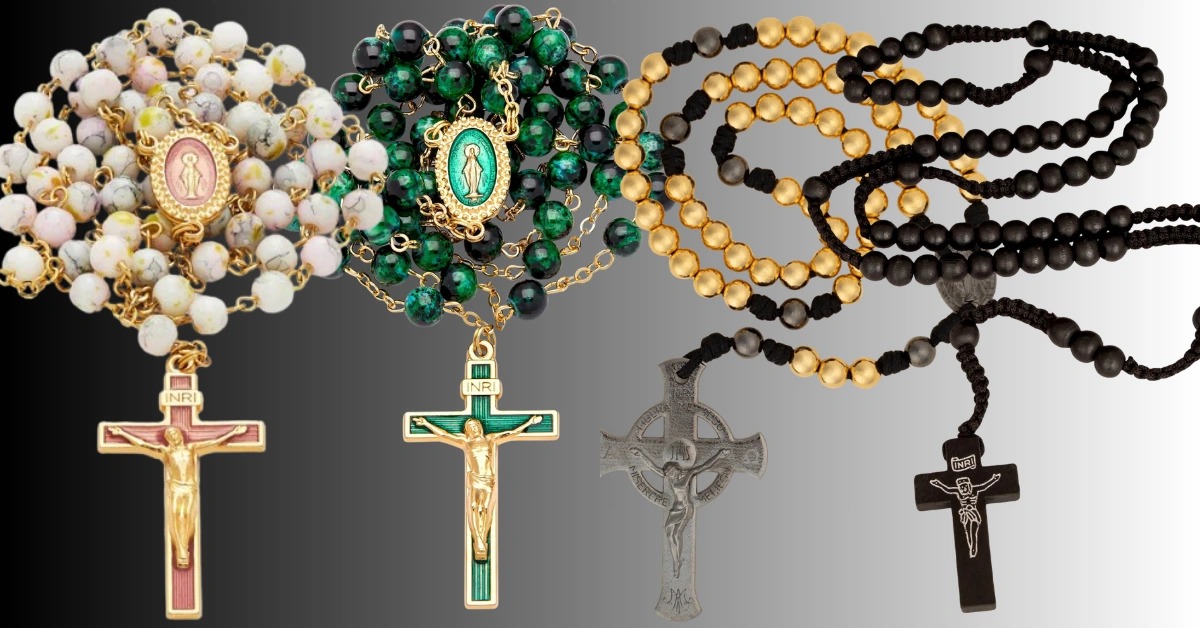
Every color of the rosary tells a story. In Catholic devotional tradition, color has never been decorative. It has always been theological — a language spoken through sacred objects, liturgical vestments, church windows, and the beads that pass through the hands of the faithful during prayer.
The white rosary meaning differs fundamentally from the black rosary meaning. The rose quartz rosary carries a different spiritual weight than the amethyst rosary. Each color, each gemstone, each material chosen for a set of prayer beads reflects something specific about the devotion, the mystery, and the soul of the person praying.
This guide covers every major Catholic rosary color — white, black, purple, green, gold, and the gemstone rosaries that have carried sacred meaning through centuries of Catholic prayer.
Why Rosary Color Matters in Catholic Tradition
The Catholic Church has always understood that human beings are not purely spiritual creatures. Faith reaches the soul through the senses — through music, through incense, through the visual richness of sacred art, and through the tactile experience of holding a rosary during prayer.
Color speaks to the senses before the intellect processes it. A red rosary communicates sacrifice before a single prayer is spoken. A white rosary communicates purity before the first Hail Mary is recited. This is not superstition — it is the Catholic theology of sacramentals, physical objects that dispose the soul toward grace through their sacred associations.
Understanding the full spectrum of Catholic rosary colors transforms the rosary from a counting device into a complete devotional language.
The three rosary colors covered in depth in this series — pink rosary meaning, red rosary meaning, and blue rosary beads meaning — form the Marian and Christological foundation of this color theology. This article completes the picture.
White Rosary Meaning — Purity, New Life, and Sacred Beginnings
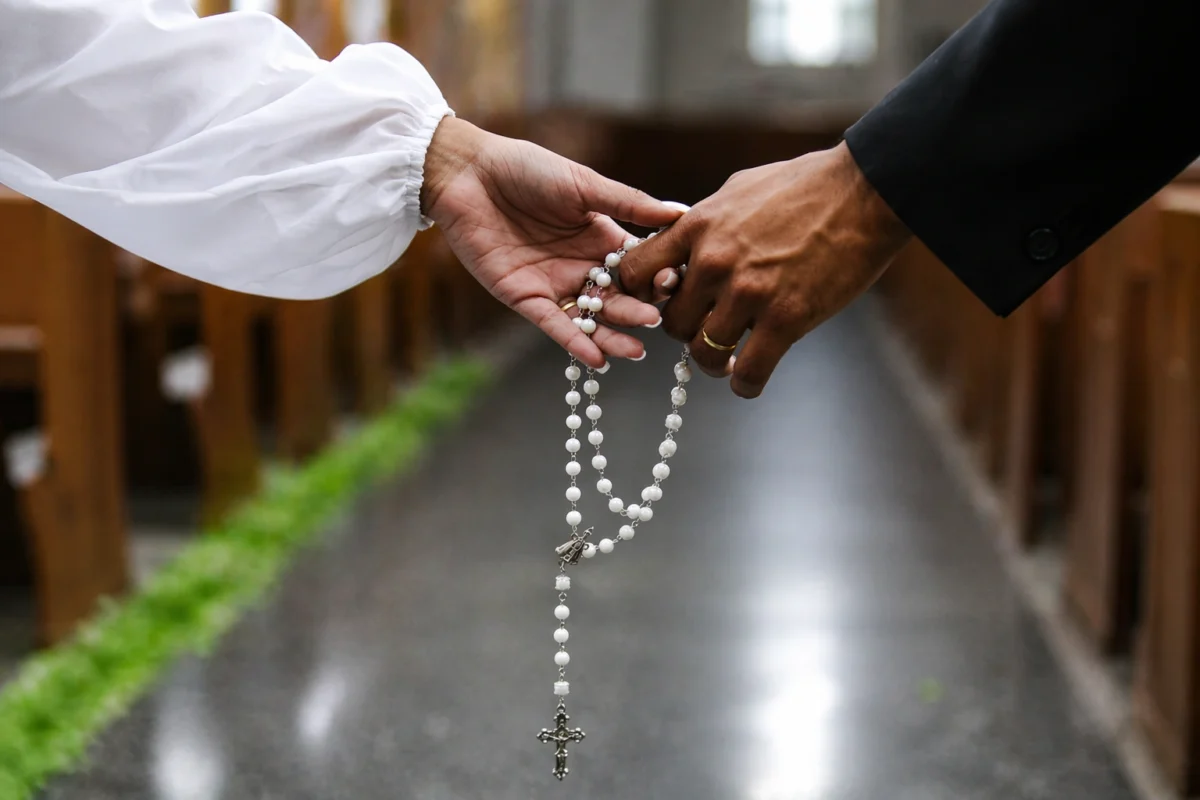
White is the color of Easter Sunday. In the Catholic liturgical calendar, white vestments appear on the two greatest feasts of the year — Christmas and Easter — and on the feast days of virgins, confessors, and the Blessed Virgin Mary herself. White is the color of divine light, of baptismal grace, of the soul restored to its original purity through the sacraments.
The white rosary meaning flows directly from this liturgical tradition:
Purity and innocence — White has represented moral and spiritual purity since the earliest centuries of the Church. The white garment given at baptism — the chrism — is the first sacred white object a Catholic receives, symbolizing the new life of grace that washes away original sin.
New beginnings in faith — Every major sacramental threshold in Catholic life is accompanied by white. Baptism, First Communion, Confirmation, marriage — each begins under the color of light and new life.
The Resurrection — White is Easter’s color because it is the color of the Risen Christ. The angels at the empty tomb were clothed in white. The Book of Revelation describes the saints in heaven wearing white robes washed in the blood of the Lamb.
A white rosary gifted at First Communion places the child’s entire prayer life under the symbolism of that first encounter with the Eucharist — pure, new, and luminous. A white rosary at a Catholic wedding accompanies the couple into a vocation that the Church calls a participation in the love of Christ for His Church.
Our white crystal rosary is crafted for exactly these sacred thresholds — its clarity and light reflecting the purity of the occasions it accompanies.
White Rosary and the Glorious Mysteries
The white rosary finds particular resonance with the Glorious Mysteries — the five meditations on the Resurrection, Ascension, Pentecost, Assumption, and Coronation. These are the mysteries of triumph and light, of death overcome and heaven opened. Praying them with white beads aligns the color of the rosary with the luminous reality being contemplated.
Black Rosary Meaning — Penance, Spiritual Warfare, and Solemn Devotion

Black is the color of serious prayer. In the Catholic liturgical calendar, black vestments were traditionally worn on Good Friday and All Souls Day — the two great commemorations of death and judgment. Black carries the weight of mortality, penance, and the spiritual warfare that Catholic tradition has always acknowledged as the daily reality of the Christian life.
The black rosary meaning is built on three theological pillars:
Penance and mortification — Black is the color chosen by those who pray the rosary as an act of reparation — for their own sins, for the sins of others, for the reparation that the Sacred Heart of Jesus and the Immaculate Heart of Mary have specifically requested through their apparitions.
Spiritual warfare — The black rosary is strongly associated with protective prayer. Saint Louis de Montfort, the great apostle of the rosary, described it as a weapon against the powers of darkness. Black — the color of the night that precedes the dawn — is the natural color for this dimension of rosary prayer.
Mourning and intercession for the dead — Black rosaries are frequently used when praying for the souls of the deceased, particularly during the month of November when the Church focuses its prayers on the Poor Souls in Purgatory.
Our black crystal rosary necklace is built for this kind of prayer — serious, disciplined, and rooted in the full weight of Catholic devotional tradition.
Black Tourmaline Rosary — Protection and Spiritual Strength
Among the gemstone rosaries, the black tourmaline rosary holds a particularly strong association with spiritual protection in Catholic sacramental tradition.
Black tourmaline is a naturally occurring stone with deep black coloring and a vitreous luster. In Catholic devotional practice, a black tourmaline rosary combines the theological symbolism of black — penance, spiritual warfare, solemn prayer — with the natural weight and tactile quality of genuine stone.
Those who pray with a black tourmaline rosary often do so with specific intentions of spiritual protection — for themselves, their families, or their communities — drawing on the long Catholic tradition of using natural materials in sacred objects as expressions of faith in God’s sovereignty over all creation.
Purple and Amethyst Rosary Meaning — Penance, Royalty, and Liturgical Seasons
Purple is the color of Advent and Lent. In the Catholic liturgical calendar, purple vestments accompany the two great seasons of preparation and penance that frame the year — the four weeks of Advent waiting for the Incarnation, and the forty days of Lent preparing for the Passion and Resurrection.
Purple carries the dual meaning of penance — the humility and self-denial of preparation — and royalty — the dignity of Christ the King whose coming is anticipated in Advent and whose kingship is revealed through the Cross in Lent.
A purple rosary prayed during Advent or Lent becomes a liturgical instrument — its color in perfect harmony with the season’s spirit, its beads counting days of waiting or reparation.
Amethyst Rosary — Sobriety, Wisdom, and Episcopal Dignity
The amethyst rosary carries the purple tradition into the realm of Catholic gemstone symbolism with particular richness.
Amethyst — the violet-purple gemstone — has deep roots in Catholic sacred tradition. Bishops and cardinals have worn amethyst rings since the medieval period, the stone chosen for its symbolic associations with sobriety, wisdom, and episcopal dignity. Saint Valentine, whose feast the Church celebrates on February 14, is said to have worn an amethyst ring engraved with the image of Cupid — a stone associated with faithful, sober love.
An amethyst rosary draws all of this tradition into the hands of the person praying — the purple of Lent and Advent, the episcopal dignity of the stone, and the deep violet color that sits at the threshold between the red of sacrifice and the blue of heaven.
Among Catholic gemstone rosaries, the amethyst rosary is one of the most theologically layered choices a devotee can make.
Rose Quartz Rosary — Marian Love, Healing, and the Mystical Rose
The rose quartz rosary occupies a unique place among Catholic gemstone rosaries — sitting at the intersection of the pink rosary’s Marian symbolism and the deeper tradition of sacred stones in Catholic devotion.
Rose quartz is a naturally pink-hued quartz crystal whose soft, translucent color has been associated with love, gentleness, and healing across many cultures. In Catholic devotional practice, the rose quartz rosary draws its meaning primarily from Marian symbolism — the rose as the defining symbol of the Virgin Mary, the Mystical Rose of the Litany of Loreto.
The rose quartz rosary is particularly chosen for:
- Marian consecration — as a physical expression of total devotion to Our Lady
- Prayers for healing — the gentle pink of rose quartz carrying the consoling, maternal dimension of Mary’s intercession
- Gifts for women and mothers — the natural beauty of the stone making it one of the most cherished of all Catholic gemstone rosaries
- Meditation on the Joyful Mysteries — where Mary’s tender love and joy are most fully present
A rose quartz rosary prayed with attention to Our Lady’s role as the Mystical Rose becomes a continuous act of Marian devotion — each bead the color of the rose that has always represented her.
Green Rosary Meaning — Hope, Ordinary Time, and Growth in Faith
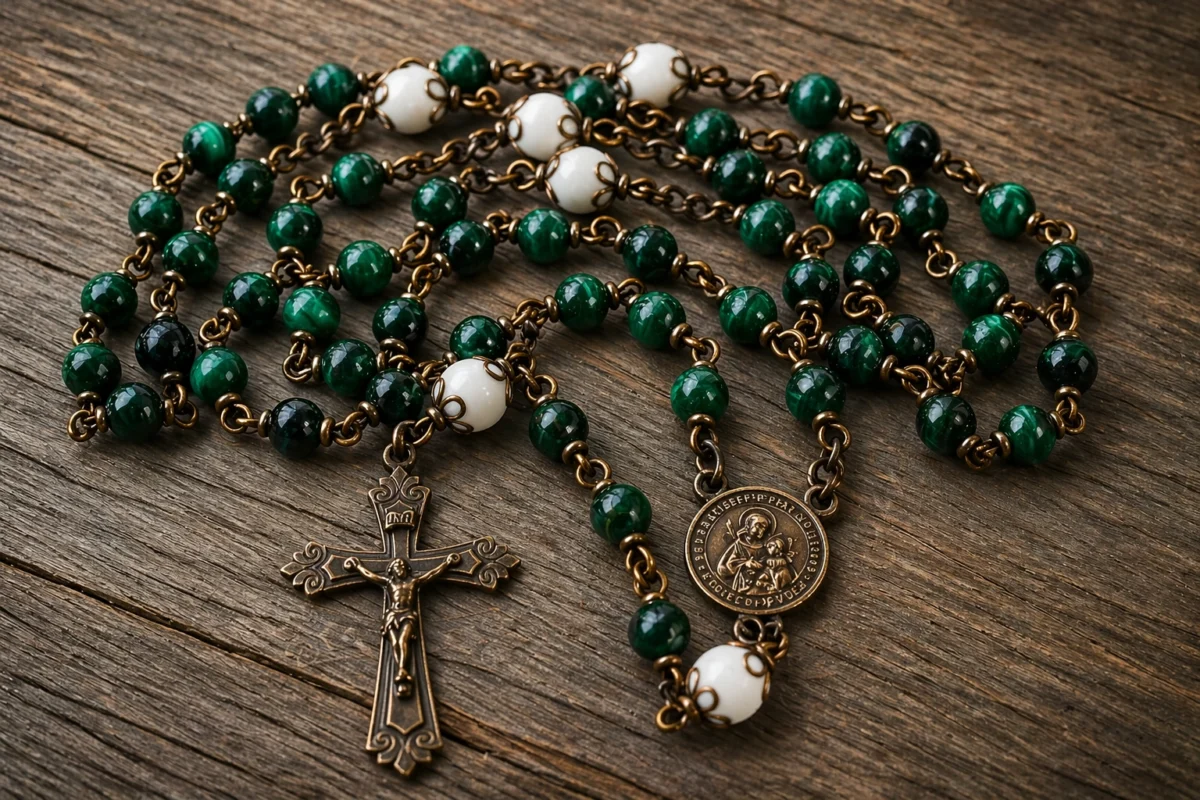
Green is the color of Ordinary Time — the long season of the Catholic year between Pentecost and Advent when the Church is not celebrating a particular mystery but simply living the faith, growing in it, and allowing it to take deeper root.
The green rosary meaning centers on hope — the theological virtue that orients the Catholic soul toward its eternal destiny — and on the patient, unhurried growth of genuine faith. Not the dramatic conversion moments but the steady daily prayer that builds a life of holiness over decades.
Green is also the color of creation — of the natural world that Catholic tradition has always seen as a reflection of the Creator’s goodness and beauty. A green rosary carries a creation theology within it, connecting the prayer of the rosary to the broader Catholic understanding that all of creation is ordered toward God.
Those who pray the rosary daily as a simple act of fidelity — not for dramatic spiritual experiences but for the quiet, consistent nourishment of the soul — often find the green rosary the most honest expression of where they are in their faith.
Gold Rosary Meaning — Divine Glory and the Glorious Mysteries
Gold in Catholic tradition carries the unambiguous symbolism of divine glory.
From the gold of the Ark of the Covenant to the gold of the tabernacle, from the gold vestments of Christmas and Easter to the golden vessels of the Eucharist, gold has always represented the transcendent splendor of God — the beauty that exceeds all natural beauty and points toward the beatific vision.
A gold rosary is the natural companion for the Glorious Mysteries — the five meditations on the Resurrection, Ascension, Pentecost, Assumption, and Coronation that close the rosary’s cycle with triumph and glory. Praying these mysteries with gold beads aligns the color of the object in the hands with the color of the reality being contemplated.
Catholic Gemstone Rosaries — Natural Materials and Sacred Meaning
Beyond color, the material of a rosary carries its own theological dimension. Catholic sacramental tradition has always valued the use of natural materials — wood, stone, crystal, metal — in sacred objects, because natural materials participate in the goodness of creation and connect the prayer of the rosary to the physical world that God made and called good.
Among the most significant Catholic gemstone rosaries:
Rose Quartz — Marian love, healing, gentleness, the Mystical Rose Amethyst — Penance, wisdom, Advent and Lent, episcopal dignity Black Tourmaline — Spiritual protection, solemn prayer, warfare against darkness Garnet — The Precious Blood, martyrdom, courageous love Lapis Lazuli — Heaven, Marian blue, divine wisdom Clear Crystal — Divine light, transparency before God, the clarity of faith
Each of these stones has been used in Catholic sacred art and devotional objects across centuries — their natural beauty a reflection of the Creator’s artistry and their symbolic associations deepened through centuries of Christian use.
Choosing the Right Rosary Color for Your Devotion
The full spectrum of Catholic rosary colors forms a complete devotional language. Understanding that language allows the choice of a rosary to become itself an act of prayer — a declaration of intention made before the first bead is touched.
A summary of the complete color theology:
- Pink — Joy, Marian tenderness, the Joyful Mysteries, the Mystical Rose.
- Red — The Precious Blood, the Sacred Heart, martyrdom, the Sorrowful Mysteries.
- Blue — The Virgin Mary, heaven, peace, Lourdes and Fatima, the Glorious Mysteries.
- White — Purity, baptismal grace, the Resurrection, sacred beginnings.
- Black — Penance, spiritual warfare, intercession for the dead, solemn devotion.
- Purple / Amethyst — Advent, Lent, penance, royal dignity of Christ.
- Green — Hope, Ordinary Time, steady growth in faith.
- Gold — Divine glory, the Glorious Mysteries, the splendor of God.
- Rose Quartz — Marian love, healing, the Mystical Rose.
- Black Tourmaline — Spiritual protection, serious penitential prayer.
Conclusion
The Catholic rosary color tradition is not a modern invention or a marketing convenience. It is a theological language centuries in the making — rooted in liturgical color, Marian iconography, gemstone symbolism, and the Catholic understanding that the physical world carries spiritual meaning.
White for purity. Black for penance. Purple for waiting. Green for hope. Gold for glory. Rose quartz for the Mystical Rose. Amethyst for wisdom. Black tourmaline for the warfare of prayer. Each color a different angle on the same infinite reality — the love of God made accessible through the beads of a rosary held in human hands.
Our handcrafted catholic rosaries are made with this tradition in mind — each color chosen with theological intention, each material selected to carry the full weight of what Catholic devotion has always understood about beauty, prayer, and the language of faith.
Frequently Asked Questions
A white rosary symbolizes purity, innocence, baptismal grace, and new life in the faith. White is the liturgical color of Christmas, Easter, and the feast days of the Virgin Mary — making it the most naturally joyful and luminous of all rosary colors. It is the traditional choice for First Communion, baptism, and wedding gifts in Catholic culture.
A black rosary carries the Catholic symbolism of penance, spiritual warfare, and solemn intercessory prayer. It is associated with prayers for the souls of the deceased, acts of reparation, and the protective dimension of the rosary as a weapon against spiritual darkness. Black tourmaline rosaries extend this symbolism through the natural stone’s association with protection and strength.
A rose quartz rosary is used primarily for Marian devotion — its natural pink color connecting it to the rose symbolism of the Blessed Virgin Mary as the Mystical Rose of the Litany of Loreto. It is also chosen for prayers of healing and for meditation on the Joyful Mysteries, where Mary’s tender love and joy are most fully present in the rosary’s cycle.
An amethyst rosary draws from the Catholic liturgical color of purple — penance, Advent, Lent, and the royal dignity of Christ. The amethyst stone itself has deep roots in Catholic tradition through its use in episcopal rings, symbolizing sobriety, wisdom, and faithful love. It is a deeply layered choice for those who pray the rosary as an act of penance or during the Church’s penitential seasons.
Yes. The Catholic tradition of sacramentals encompasses a wide range of natural materials used in devotional objects — including precious and semi-precious stones. The Church has never restricted rosary beads to specific materials. Natural gemstone rosaries connect the prayer of the rosary to the broader Catholic theology of creation — the natural world as a reflection of the Creator’s beauty and goodness.
No. The prayers of the rosary — the Apostles’ Creed, the Our Father, the Hail Mary, the Glory Be, and the Fatima Prayer — are identical regardless of the color or material of the beads. Color shapes the interior disposition brought to the prayer, not the prayer itself. The color of a rosary is a devotional choice, not a liturgical requirement.