
Blog
Green Rosary Meaning: Hope, Healing, and the Catholic Theology of Ordinary Time

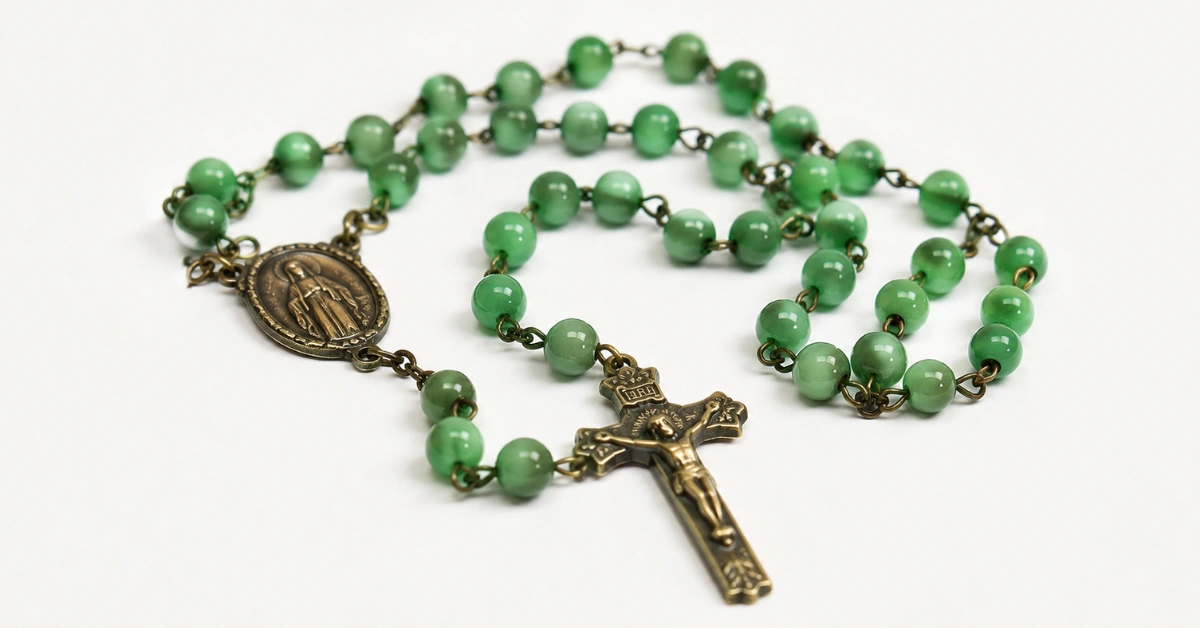
Green is the color of faith that does not require drama to survive. Every other rosary color carries an intensity that announces itself — the passion of red, the solemnity of black, the penitential weight of purple, the luminosity of white. Green makes no such announcement.
It is the color of grass growing steadily beneath the feet of someone who is not looking down. It is the color of the long season of the Catholic year when nothing particular is being celebrated and nothing extraordinary is being demanded — when the Church simply asks its faithful to grow, day by day, in the direction of God.
The green rosary meaning is built on this quiet theology — the theology of Ordinary Time, of patient hope, of healing that unfolds slowly and of faith that deepens not in the dramatic moments but in the faithfulness of the unremarkable ones.
Green in Catholic Liturgical Tradition — Ordinary Time
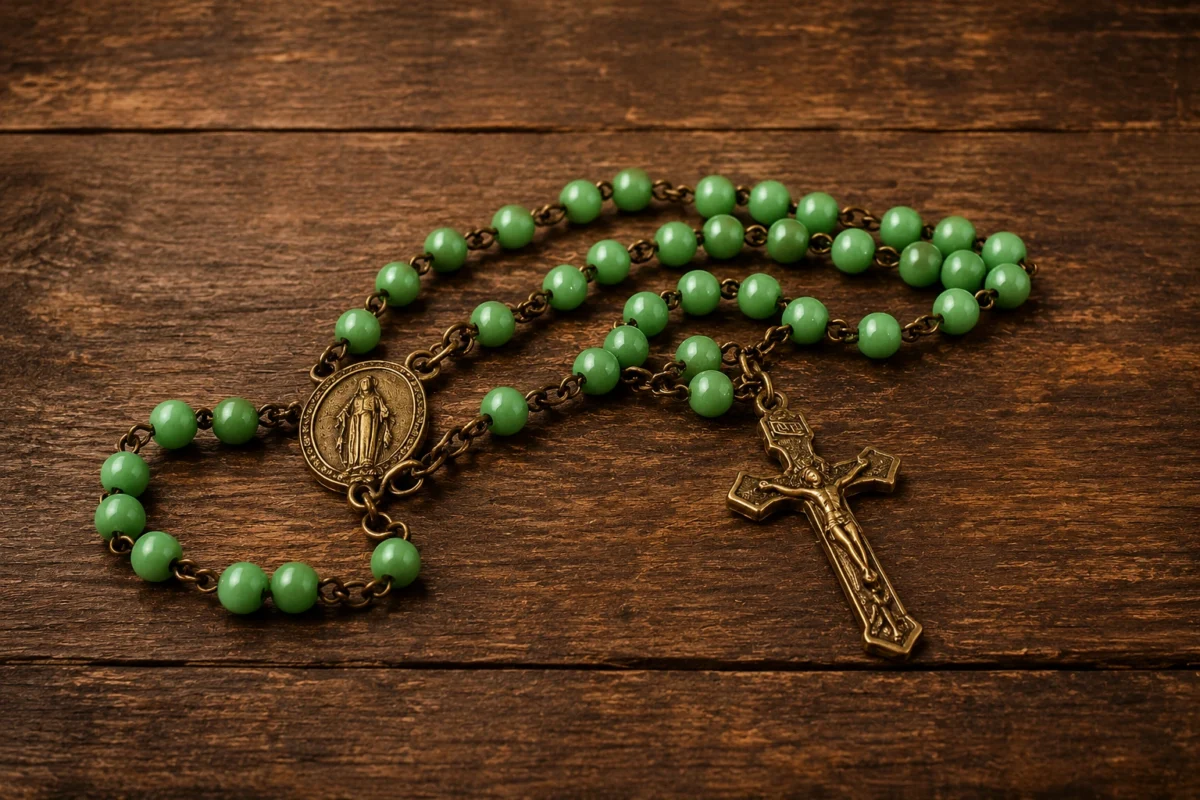
The Catholic liturgical calendar assigns green to Ordinary Time — the longest season of the year, encompassing the weeks between the Christmas season and Ash Wednesday and the longer stretch between Pentecost Sunday and the First Sunday of Advent.
Ordinary Time accounts for approximately thirty-three to thirty-four weeks of the liturgical year — by far the longest single season, dwarfing Advent, Christmas, Lent, and Easter combined. Green vestments fill Catholic churches throughout this entire period, making green the color Catholics encounter most consistently across the breadth of their liturgical year.
The word “ordinary” in Ordinary Time does not mean unimportant. It derives from the Latin ordinalis — meaning counted or ordered. Ordinary Time is simply the counted weeks of the year that fall outside the great feasts and their preparatory seasons. It is the time when the Church does not focus on a specific mystery of Christ’s life but simply lives out the faith — growing in it, practicing it, allowing it to take deeper root through the unremarkable faithfulness of daily prayer.
Green was assigned to this season with theological precision. Where the dramatic seasons of the year carry the colors of their specific theological content, Ordinary Time carries the color of creation itself — the green of the natural world growing steadily in the direction of the sun, bearing fruit not in sudden bursts but in the slow accumulation of a season.
Green Rosary Beads Meaning — The Complete Theology
Hope — The Theological Virtue
The primary theological meaning of the green rosary is hope — the theological virtue that Catholic tradition distinguishes sharply from optimism.
Optimism is a temperament — the natural disposition of some personalities to expect good outcomes. Hope is a virtue — the specific disposition of the Catholic soul toward the certainty of God’s promises, rooted not in favorable circumstances but in the reliability of the God who made them. Hope persists in circumstances that extinguish optimism. It is the faith that knows winter ends even when it cannot see the spring, the prayer prayed in darkness by a soul that does not feel the presence it invokes but continues invoking it because the promise was made and the promiser does not lie.
Green is the color that carries this theological virtue most naturally — its color the color of the created world pressing steadily upward toward the light, bearing the fruit of patient growth rather than the sudden harvest of dramatic intervention. A green rosary prayed in a season of spiritual aridity — when prayer feels empty, faith feels distant, and the consolations of early devotional life have given way to the dry faithfulness of mature prayer — is the most honest expression of theological hope available to a Catholic in that moment.
Growth in Faith — The Long Work of Sanctification
Catholic spiritual tradition distinguishes three stages of the spiritual life — the purgative way, the illuminative way, and the unitive way — through which the soul progressively deepens its relationship with God through the patient work of years and decades rather than the dramatic conversion of a single moment.
The green rosary carries the symbolism of this long growth — the patient, incremental, largely invisible deepening of faith that constitutes the bulk of every genuine Catholic spiritual life. The years of daily rosary prayed with neither particular consolation nor particular difficulty, the Hail Marys said when nothing feels special about saying them, the decades completed in faithfulness when faithfulness is all that remains — this is the green rosary’s territory.
This is precisely what makes the green rosary the most honest choice for many Catholics who have prayed the rosary for years and find themselves in the long middle ground of mature faith — past the initial fervor of conversion or recommitment, not yet at the unitive depth of the great mystics, but growing steadily in the direction of God through the unremarkable fidelity of daily prayer.
Healing and Renewal
Green in the natural world is inseparable from healing and renewal — the green of new growth emerging from winter-damaged ground, the green of the living plant recovering from drought, the green that returns to a landscape after fire has passed through it.
This natural symbolism has been absorbed into Catholic devotional practice in a specific and practical way — the green rosary is widely chosen for prayers of healing. Catholics praying for sick family members, for recovery from illness, for the restoration of health in situations where medicine has reached its limits, frequently reach for a green rosary whose color speaks the language of the healing they are asking for.
This is not a canonical rule — the Church assigns no official healing significance to the green rosary. It is the accumulated devotional instinct of centuries of Catholics who have understood that the natural world speaks theological language and that the green of healing in creation corresponds to the healing they seek from the Creator who made that creation.
Creation and the Natural World
Green is the color of the created world in its most immediately recognizable form — the forests, grasslands, fields, and gardens that cover the earth God made and called good at the conclusion of the first creation account in Genesis.
The green rosary prayed with attention to this dimension of its color becomes a creation prayer — each bead a moment of gratitude for the natural world through which Catholic tradition has always understood God to speak. Saint Francis of Assisi, whose Canticle of the Sun is one of the great Catholic hymns of creation, prayed in the green of the Italian countryside with a sensitivity to creation as theological language that the green rosary naturally expresses.
Archbishop Fulton Sheen’s World Mission Rosary — Green for Africa
One of the most specific and historically documented uses of green in Catholic rosary tradition comes from one of the twentieth century’s greatest Catholic communicators — Archbishop Fulton J. Sheen.
In 1951, Archbishop Sheen — then serving as national director of the Society for the Propagation of the Faith — proposed the World Mission Rosary, asking his listeners to “embrace the world in prayer.” The World Mission Rosary assigns a specific color to each of the five decades, each representing a specific region of the world:
- Green — the forests and grasslands of Africa
- Blue — the oceans surrounding the islands of the Pacific
- White — Europe, home of the Holy Father
- Red — the fire of faith that brought the first missionaries to the Americas
- Yellow — the morning light of the East, symbolizing Asia and the Middle East
In this context, green carries a missionary dimension alongside its liturgical symbolism — the decade prayed on green beads becoming a prayer for the Church in Africa, for the missionaries who serve there, for the Catholic communities growing steadily across the continent’s vast forests and grasslands.
A green rosary prayed with this Fulton Sheen tradition in mind becomes a genuinely missionary prayer — the person holding it reaching across the world in intercession for brothers and sisters in faith whose spiritual lives unfold in circumstances entirely different from their own.
Light Green vs Dark Green Rosary Meaning
The range of greens available in rosary beads carries subtly different devotional dimensions:
Light green (mint, sage, spring green) carries the symbolism of new growth, fresh beginnings, and the early stages of healing or spiritual renewal. A light green rosary is particularly suited to prayers for recovery, for new beginnings in faith, for those returning to the Church after a period of distance. Its lightness speaks of gentleness — the early and tender growth of a faith being slowly restored.
Dark green (forest green, emerald, hunter green) carries the deeper symbolism of mature growth, established faith, and the solid hope of a soul long rooted in prayer. A dark green rosary is particularly suited to the long middle seasons of Catholic life — the decades of steady prayer that constitute the bulk of genuine spiritual growth. Its depth speaks of solidity — the faith that has survived enough seasons to know that green always returns.
Jade and Emerald Rosary Meaning — The Gemstone Tradition
Within the Catholic gemstone rosary tradition, two natural green stones carry specific devotional significance.
Jade — a naturally green stone valued across cultures for centuries — carries associations with wisdom, steadiness, and the patient endurance that Catholic spiritual tradition connects to the theological virtue of hope. A jade rosary combines the natural beauty of genuine stone with the theological weight of green’s Catholic meaning — each bead carrying both the earth’s own artistry and the accumulated devotional significance of the color.
Emerald — the vivid green gemstone whose intense color comes from chromium within its crystal structure — carries the most vivid expression of green available in natural stone. An emerald rosary catches light with the same depth that the finest crystal rosary necklaces achieve through glass — its color carrying the deep, mature hope that Catholic faith calls the most persevering of all theological virtues.
Green Rosary as a Gift — The Perfect Occasions
The green rosary is among the most naturally meaningful gifts for several specific situations Catholic life regularly produces:
For someone facing illness — the healing symbolism of green speaks directly to the specific prayer being offered without requiring explanation. A green rosary placed in the hands of a Catholic facing serious illness is immediately understood as a prayer for the recovery its color represents.
For someone returning to faith — the symbolism of new growth and renewal makes the green rosary the most honest gift for a Catholic who has been away from the faith and is finding their way back. Its color carries hope without pressure — the patient optimism of a color that knows growth takes time.
For someone in a long spiritual season — many Catholics go through extended periods when faith feels neither particularly consoling nor particularly difficult. A green rosary given to someone in this season acknowledges and honors where they are rather than implying they should be somewhere more dramatic.
For nature lovers and creation-conscious Catholics — those whose faith is expressed through attention to the natural world find in the green rosary the most direct connection between their creation spirituality and their Marian devotion.
Green Rosary and the Luminous Mysteries
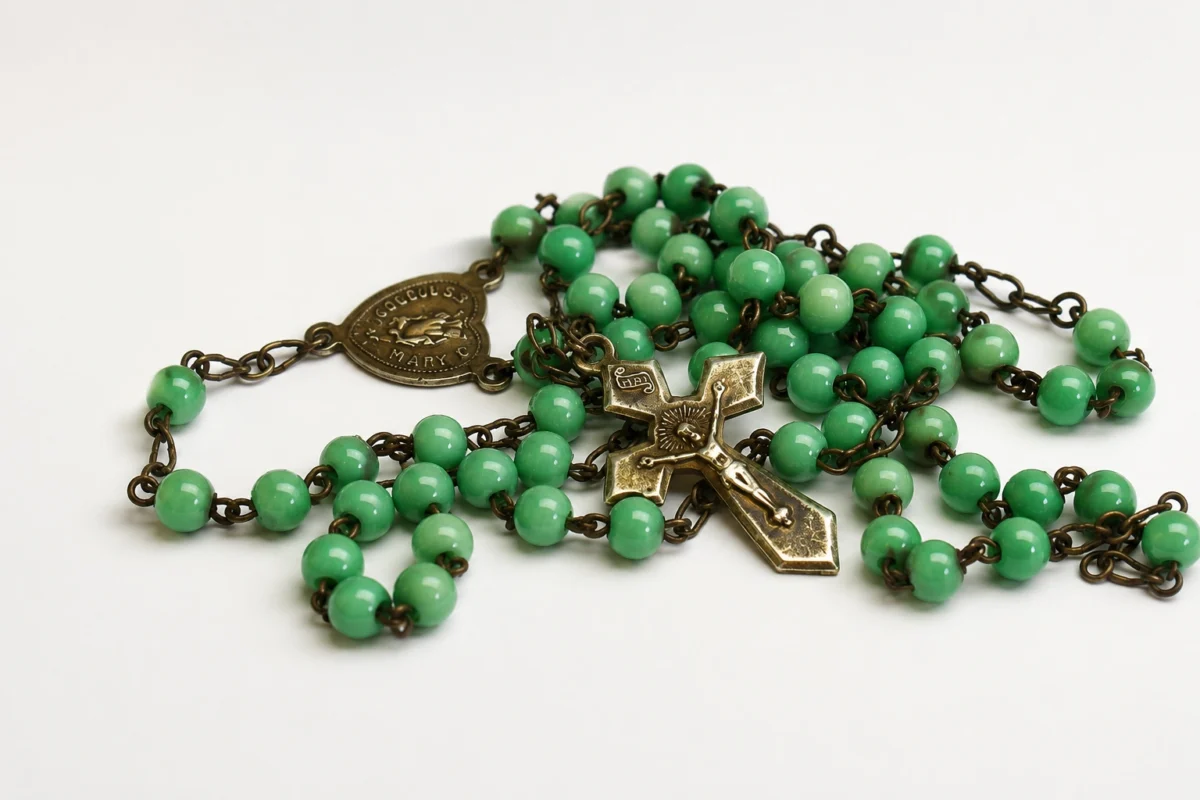
While the green rosary does not have a single specific set of mysteries assigned to it, it finds particular resonance with the Luminous Mysteries — the five meditations on Christ’s public ministry added to the rosary by Pope John Paul II in 2002.
The Luminous Mysteries cover the period of Christ’s public life — the years of His ministry in Galilee and Judea, walking through the green landscapes of the Holy Land, teaching in the open air, healing the sick, feeding the hungry. These are the mysteries of Christ at work in the world — the incarnate God doing the ordinary extraordinary things that the Gospel records with quiet attention to detail.
A green rosary prayed through the Luminous Mysteries connects the color of Ordinary Time with the mysteries of Christ in His ordinary extraordinary ministry — each decade a meditation on the God who worked His redemption not only in the dramatic events of the Passion and Resurrection but in the patient, daily, green-season work of teaching, healing, and calling disciples to follow.
Understanding the full connection between rosary colors and the mysteries they most naturally serve is explored in our complete guide to all rosary colors and their meanings — the green rosary sitting within a complete theological spectrum that covers every dimension of Catholic devotional life.
Conclusion
The green rosary does not announce itself. It does not carry the fire of red or the solemnity of black or the penitential weight of purple. It carries something quieter and in many ways more demanding — the steady, patient, unremarkable faithfulness of a faith that keeps growing even when it cannot feel itself growing.
Hope is the theological virtue that persists when optimism has nothing left to stand on. Growth is the spiritual reality that unfolds most deeply in the seasons when nothing dramatic seems to be happening. Healing is the grace that comes slowly, like green returning to winter-damaged ground, visible only when the season has done its full work.
The green rosary is the rosary for exactly these realities — for the Catholic who prays without consolation, who hopes without certainty of outcome, who grows without being able to measure the growth, and who trusts that the God who made green made it for a reason.
Frequently Asked Questions
A green rosary symbolizes hope, healing, spiritual growth, and Ordinary Time in Catholic tradition. Its color reflects the liturgical season when the Church grows steadily in faith rather than celebrating specific mysteries — the most honest color for the long, patient middle of a Catholic spiritual life.
A green rosary communicates hope, healing, and patient growth — the most meaningful choice for someone facing illness, returning to faith, or living through a long season of spiritual steadiness. Its color speaks its intention before a single word of explanation is offered.
In Archbishop Fulton Sheen’s World Mission Rosary, the green decade represents Africa — its color drawn from the continent’s forests and grasslands. Praying the green decade as a missionary prayer for the Church in Africa gives the green rosary a specific intercessory dimension rooted in one of the twentieth century’s greatest Catholic traditions.
Yes — green is the liturgical color of Ordinary Time, making a green rosary particularly suited to prayer during the long seasons between Christmas and Lent and between Pentecost and Advent. It can be prayed year-round but carries its most direct liturgical resonance during these extended seasons.
A jade rosary carries the warmth and steadiness of a naturally green stone associated with wisdom and patient endurance. An emerald rosary carries the most vivid expression of green in natural stone — its intense color reflecting the deep, mature hope of a faith long rooted in prayer.
The green rosary finds its most natural home in the Luminous Mysteries — Christ’s public ministry in the green landscapes of the Holy Land — and in the general daily prayer of Ordinary Time. It can be prayed with any set of mysteries according to personal devotional intention.